Indian Textile Stories: How Traditional Fabrics Inspire Modern Pattern Design
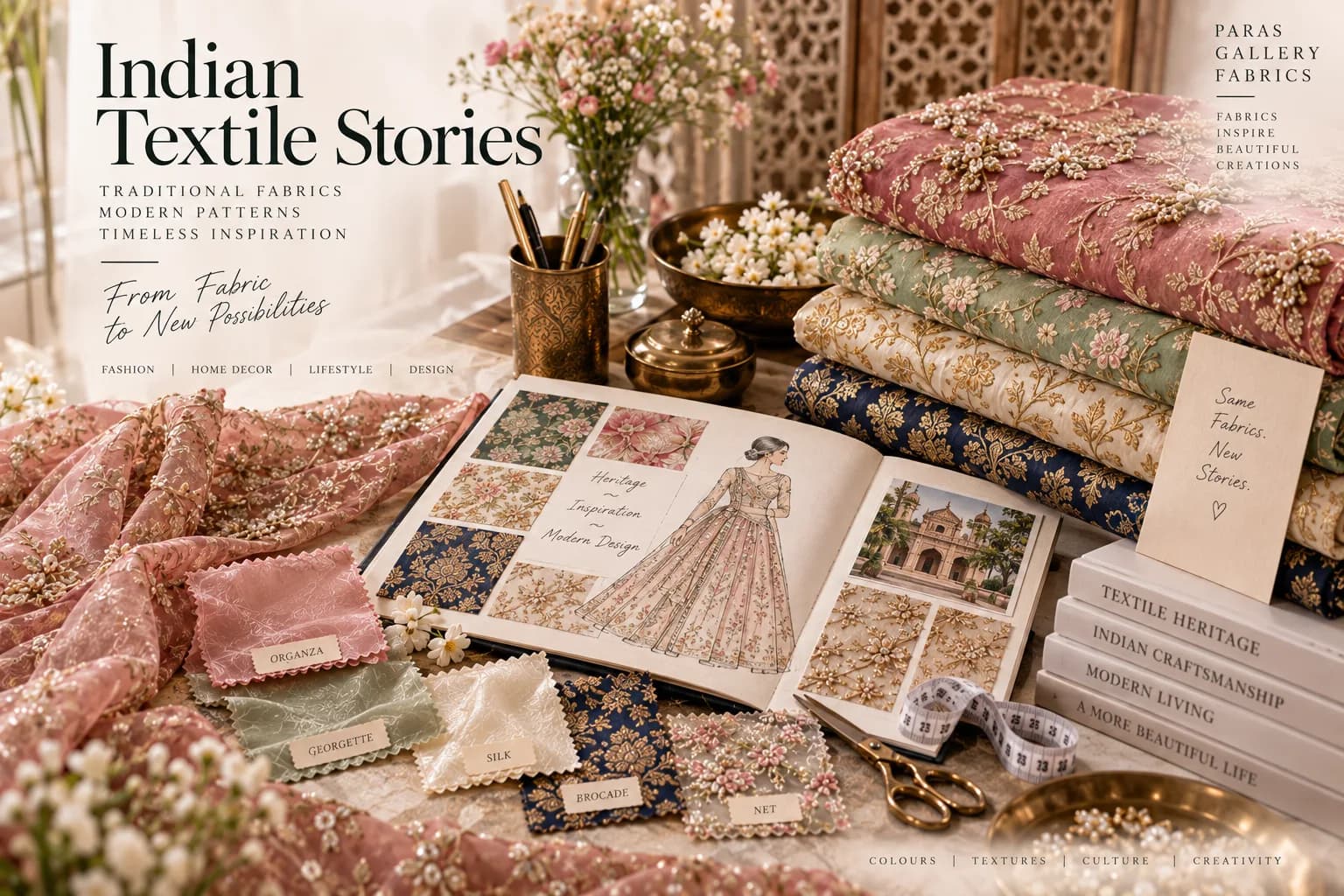
India has a long and diverse textile tradition. From intricate brocades and delicate organza to flowing georgette, patterned jacquards and richly detailed silks, fabrics have always been more than materials. They carry colour, craftsmanship, regional influences and stories.
At Paras Gallery Fabrics, we see this relationship between textile heritage and contemporary design every day. Our work with fabrics has inspired us to explore how traditional Indian textile details can be translated into fresh patterns for modern creative projects.
From Fabric to Pattern
A beautiful fabric often begins with a small visual detail.
It might be a paisley tucked into a brocade, a floral vine running across an embroidered surface, a tiny buti repeated across silk, or the subtle texture of zari-inspired ornamentation.
These details can become the starting point for an entirely new pattern.
Instead of reproducing a particular fabric, designers can take inspiration from its visual language—its rhythm, spacing, scale, colour relationships and decorative character—and reinterpret those elements in an original way.
This approach allows traditional influences to feel relevant in contemporary interiors, apparel, accessories and creative projects.
The Beauty of Indian Floral Motifs
Floral decoration is one of the most recognisable elements of Indian textile design.
Flowers can appear as scattered butis, dense garden arrangements, climbing vines or large ornamental compositions. Their scale can completely change the personality of a design.
A small floral repeat can feel delicate and understated, while oversized botanical motifs can create a dramatic statement.
For our Indian Textile Stories concept, floral patterns form one of the central design directions. The idea is to combine traditional botanical influences with cleaner layouts and contemporary colour palettes.
Paisley, Buti and Brocade
Indian textile design is also rich in recurring decorative forms.
The paisley is instantly recognisable, but it can be redesigned in countless ways. It can become part of a dense ornamental repeat, appear as a single statement motif, or be combined with flowers and vines.
The buti offers another interesting approach. Small repeating motifs create rhythm without overwhelming the surface, making them particularly useful for designs where subtle texture is important.
Brocade-inspired patterns take the idea further through ornamentation. Repeated florals, foliage, paisleys and geometric details can create a sense of richness even when translated into a modern two-dimensional pattern.
Colour Tells Part of the Story
Indian textiles are known for their expressive use of colour.
Deep jewel tones can create a luxurious mood, while soft pista, dusty rose, ivory and champagne can produce something much quieter. Gold-inspired details can add warmth without needing to dominate the entire design.
For a contemporary Indian-inspired collection, a balanced palette might include:
- Ivory and cream
- Antique gold
- Pista green
- Dusty rose
- Rani pink
- Deep wine
- Emerald and botanical green
- Navy blue
- Plum
The important part is not simply using many colours. It is creating relationships between them.
A muted background can allow an intricate motif to become the focus, while a dark ground can make floral or metallic-inspired details feel more dramatic.
Texture as Inspiration
Pattern design does not have to begin with a flat illustration.
Fabric itself can provide visual inspiration.
The transparency of organza, the soft movement of georgette, the richness of brocade and the surface variation of jacquard each suggest different approaches to pattern.
A sheer fabric might inspire a light, widely spaced floral design. A brocade could lead towards a denser ornamental repeat. A delicate silk buti might translate into a minimal pattern with generous negative space.
This is where textile knowledge becomes valuable for surface design.
Designing a Cohesive Collection
A collection becomes stronger when individual patterns feel connected.
One design might feature large flowers, another paisleys, and another tiny butis. They do not need to look identical. Instead, they can share elements such as colour, line quality, motif shapes or decorative influences.
For example, an Indian-inspired collection could include:
Zari Garden — delicate floral vines with ornamental details.
Banarasi Vine — paisleys and botanical forms arranged in a heritage-inspired repeat.
Pista Garden — soft florals against a gentle green ground.
Mughal Floral Trail — larger botanical compositions with a more dramatic presence.
Organza Bloom — light floral motifs with plenty of negative space.
Royal Brocade — a dense ornamental design inspired by traditional brocade structures.
Silk Buti — small repeating motifs designed for a quieter, elegant surface.
Festive Katdana — decorative clusters inspired by the sparkle and rhythm of beadwork.
Jaipur Garden Stripe — floral and ornamental elements arranged into a vertical stripe.
Heirloom Textile — a layered composition bringing paisleys, flowers, vines and small motifs together.
Together, these directions create a visual conversation between heritage and contemporary pattern design.
From Indian Textiles to Global Design
Traditional textile inspiration does not have to remain limited to traditional clothing.
Pattern can travel.
A floral motif inspired by Indian embroidery can become wallpaper. A paisley repeat can work on home accessories. A small buti can become stationery or apparel. A decorative border can inspire a modern geometric composition.
This is what makes textile heritage so interesting for designers: the original context provides inspiration, but the final application can be completely new.
Why Fabric Knowledge Matters
Understanding fabric can make a designer more thoughtful about pattern.
Scale, repeat size, density, contrast and motif placement all influence how a pattern will eventually look on a material or product.
A design that looks beautiful as a small digital tile may behave very differently when enlarged across a garment or interior surface.
That is why looking closely at real textiles remains valuable—even in an increasingly digital design environment.
At Paras Gallery Fabrics, our focus is on helping designers, boutiques and fashion enthusiasts explore the possibilities of fabric, from traditional Indian-inspired surfaces to contemporary applications.
Explore the wider world of Indian fabrics and textile inspiration at Paras Gallery Fabrics: https://parasgalleryfabrics.com/
Final Thought
Indian textiles demonstrate that a pattern can carry history without looking old-fashioned.
The most interesting contemporary designs often begin with something familiar—a flower, a paisley, a vine, a buti, a stripe—and reinterpret it through new colour, scale and composition.
That is the idea behind Indian Textile Stories: taking inspiration from the richness of Indian textiles and turning those visual stories into patterns for today's creative world.